Florida Dept of Children's and Families Access Food Assistance
What is Famine? Causes and effects and how to stop it

Dearth is not just a widespread scarcity of food, its also a political scandal. Learn more almost what famine is and what Oxfam is doing to prevent it.
A mortiferous combination of conflict, COVID-19, and climate change is increasing the number of people living in severe hunger. Oxfam estimated over the summertime of 2021 that half a million people are living in famine-similar conditions in just four countries (Ethiopia, Madagascar, Due south Sudan, and Yemen).
The COVID-19 coronavirus is affecting about all regions of the world. As country later on state has required people to stay at home and economies grind to a halt, the specter of hunger is emerging. The motion of nutrient, from farms to markets and people's homes, is existence disrupted, and the poorest and most vulnerable are at risk. The economical crisis and disruption of the food supply could push button an boosted half billion people into poverty, according to estimates by Oxfam and others.
Is a global famine really a possibility? Let's look at the definition of the word kickoff.
Famine is not but a lack of food
Dan Maxwell and Nisar Majid's 2016 book Dearth in Somalia has a good definition: "Famine is broadly understood as 'an farthermost crisis of access to adequate food, manifested in widespread malnutrition and loss of life due to starvation and infectious disease.'"
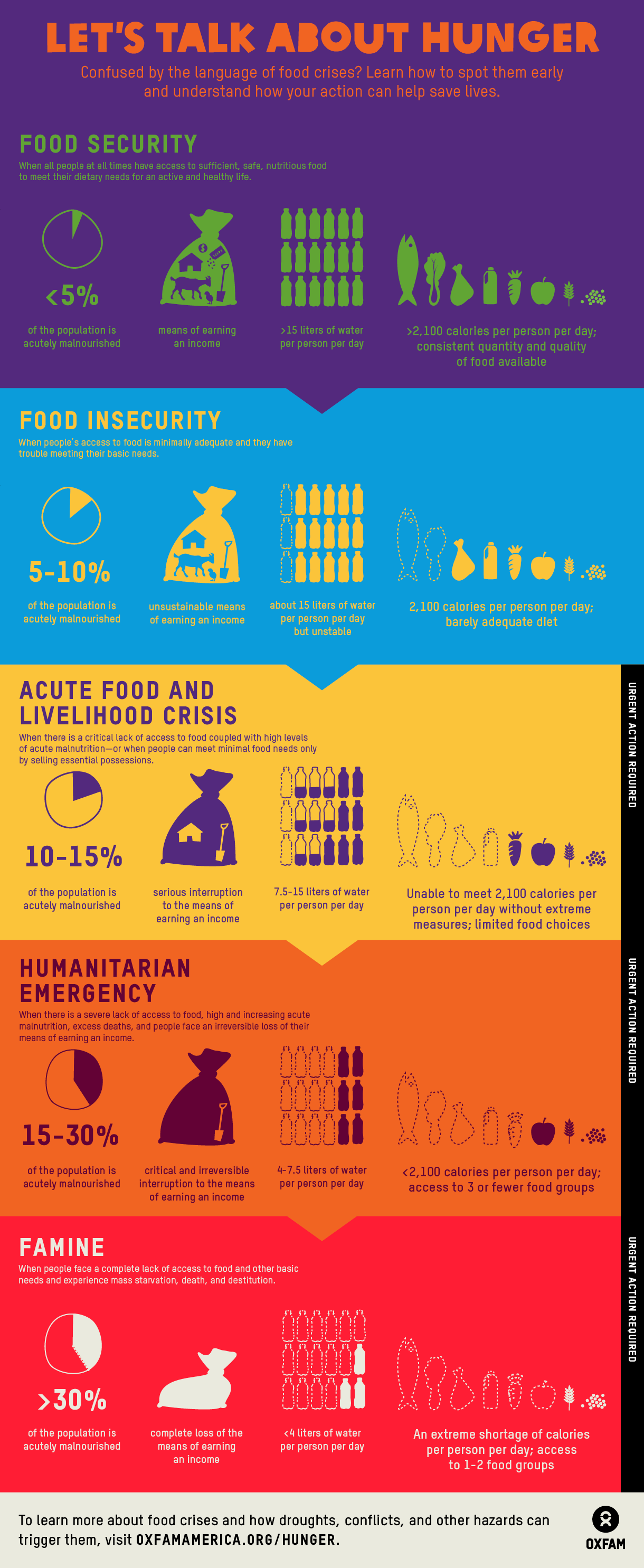
In technical terms, a dearth is a state of affairs where one in v households feel "an extreme lack of food and other basic needs where starvation, decease, and destitution are evident." More than than xxx percent of people are "acutely malnourished" and two out of every 10,000 people die from starvation. This set of conditions is the most severe case in a range of classifications monitored past the "Integrated Food Security Phase Classification" (IPC) that tracks the availability of food for people and helps governments and aid organizations anticipate a crisis before people experience famine, what the IPC calls Phase five. (Phases ii-4 are not very squeamish situations either, by the style, and equally you can see in graphic below, when people get to the famine phase, they typically take few or no resource to sustain them.)
Famine looks like a lack of food, and nigh people think it is brought on by a drought, a war, or an outbreak of disease. And some still believe in debunked 19th-century theories nigh "overpopulation" causing famine. But famines are usually acquired by multiple factors, compounded by poor (or even intentionally bad) policy decisions that make people vulnerable. When no one addresses this vulnerability, information technology leads to dearth.
This is why political scientist Alex de Waal calls famine a political scandal, a "catastrophic breakdown in government capacity or willingness to do what [is] known to be necessary to forbid dearth." When governments fail to prevent or end conflict, or help families prevent food shortages brought on past whatsoever reason, they fail their own people.
Before the COVID-19 pandemic, we have seen a dramatic decline in famines in the last l years. Unfortunately there are still some cases of conflict that have plunged millions into poverty and hunger, making people even more vulnerable to the coronavirus. Disharmonize in South Sudan and Republic of yemen has displaced families and cutting off food supplies, too as people's admission to aid. Conflict and a lengthy, serious drought in Somalia and other parts of the Horn of Africa has killed off most of the crops and livestock, the chief assets for many families. The situation in the Horn is compounded past climatic change and a contempo upsurge in desert locusts across East Africa.
The conflict in Yemen is has been going on for vi years now. Aid groups such every bit Oxfam and UN agencies (including the Dearth Early Warning System) have been warning the globe about this deteriorating state of affairs for some fourth dimension.
What Oxfam is doing to forbid dearth

Oxfam is actively working to reduce the likelihood of famine and terminate globe hunger. Hither are some ways we are getting involved:
Providing clean h2o
Clean water for drinking, cooking, and washing hands is essential in any humanitarian emergency to avoid deadly h2o-borne diseases such as cholera or coronavirus. But any stomach ailment from dingy water will rob people of the nutrition they tin can derive from whatever nutrient they can find. Children under 5 are specially vulnerable. Oxfam helps improve and repair wells, and trucks in water to areas where at that place is none.
Encouraging proper sanitation
Proper sanitation and hygiene are essential for preventing diseases like cholera, Ebola, and COVID-19. Oxfam helps construct latrines and distributes hygiene items like soap so people can wash their hands.
Distributing food
When food is bachelor in markets, but might be scarce or very expensive for some, Oxfam distributes greenbacks. Oxfam besides distributes emergency nutrient when necessary.
Planting crops
In areas where farmers can constitute crops, Oxfam is helping supply seeds, tools, and other assistance and so people can abound their own food. We also help farmers raising livestock with veterinary services, animal feed, and in some cases we distribute animals to farmers to help restock their herds.
Government accountability
We (governments, the United nations, aid organizations) know what to do considering the world has been successfully fighting famine for more a century. In 2011, more than 250,000 people in Somalia lost their lives when the earth ignored repeated warnings after the failure of rains in the region.
Oxfam and other aid organizations are studying the effects of COVID-19 on the earth's supply of food, advocating for policies that will prevent a catastrophic disruption, and helping the near vulnerable people survive the hopefully brusk-term measures to reduce the spread of the disease and the threat of famine.
Related content
 Story
Story Standing the fight confronting economic inequality
Nosotros've been advocating for the Build Back Better Human activity to be passed as presently equally possible. Where does it stand at present and where practise nosotros go from here?
 Story
Story 1 woman'south fight against inequality saves lives in her neighborhood
In Peru, Janet Fuentes mobilized her community to salvage lives during the pandemic while they received trivial to no support from the government.
 Story
Story Inequality Kills
Inequality contributes to the death of at least one person every four seconds.
Source: https://www.oxfamamerica.org/explore/stories/what-is-famine-and-how-can-we-stop-it/
0 Response to "Florida Dept of Children's and Families Access Food Assistance"
Post a Comment