High School of Art and Design Class 57 St 2nd Avwnuw New York Ny
| Top 10 NYC Architecture | summit 25 new york buildings | |||||||||||||||
| one | Empire State Building | |||||||||||||||
 |
The Empire Land Edifice has been named by the American Club of Civil Engineers every bit one of the Seven Wonders of the Modern Earth. The building and its street floor interior are designated landmarks of the New York Urban center Landmarks Preservation Commission, and confirmed by the New York City Board of Judge.[v] Information technology was designated as a National Historic Landmark in 1986.[three][vi][7] In 2007, information technology was ranked number one on the Listing of America's Favorite Compages according to the AIA. The building is owned past Harold Helmsley'south company and managed past its management/leasing division Helmsley-Spear. | |||||||||||||||
| 2 | Chrysler Building | |||||||||||||||
 |
The Chrysler Building is an Fine art Deco skyscraper in New York City, located on the eastward side of Manhattan at the intersection of 42nd Street and Lexington Artery. Standing at 319 thou (1,047 ft) loftier,[1] it was briefly the world's tallest edifice before information technology was surpassed by the Empire Land Building in 1931. However, the Chrysler Edifice remains the world's tallest brick building.[2][three] After the destruction of the Globe Trade Center, it was again the second tallest building in New York City until December 2007, when the spire was raised on the 365.8 thousand (1,200 ft) Depository financial institution of America building, pushing the Chrysler Building into tertiary position. In addition, the New York Times Building, which opened in 2007, is exactly tied with the Chrysler Building in height, making the ii buildings tied for tertiary position.[4] Despite the modify in tallness ranking in New York, the Chrysler Building is still a classic example of Art Deco architecture and considered by many, at least among contemporary architects, to exist one of the finest buildings in New York City. | |||||||||||||||
| 3 | STATUE OF Liberty | |||||||||||||||
 |
The statue is of a female figure walking upright, dressed in a robe and a 7 bespeak spiked rays representing a nimbus (halo), holding a stone tablet close to her trunk in her left manus and a flaming torch high in her correct manus. The tablet bears the words "JULY Four MDCCLXXVI" (July 4, 1776), commemorating the date of the U.s.a. Proclamation of Independence. The statue is made of a sheeting of pure copper, hung on a framework of steel (originally puddled iron) with the exception of the flame of the torch, which is coated in golden leafage. Information technology stands atop a rectangular stonework pedestal with a foundation in the shape of an irregular eleven-pointed star. The statue is 151 anxiety 1 inch (46.5 1000) tall, with the pedestal and foundation adding another 154 anxiety (46.9 m). Worldwide, the Statue of Freedom is one of the most recognizable icons of the U.s.a.,[2] and, more generally, represents liberty and escape from oppression. The Statue of Liberty was, from 1886 until the jet age, frequently one of the commencement glimpses of the United States for millions of immigrants after bounding main voyages from Europe. Visually, the Statue of Liberty appears to draw inspiration from il Sancarlone or the Colossus of Rhodes. The statue is a central part of Statue of Liberty National Monument, administered by the National Park Service. | |||||||||||||||
| 4 | St. Patrick's Cathedral | |||||||||||||||
 |
St. Patrick's Cathedral is the largest decorated Neo-Gothic-style Cosmic cathedral in N America. It is the seat of the archbishop of the Roman Catholic Archdiocese of New York, and a parish church building, located on Fifth Avenue between 50th and 51st streets in Manhattan. It faces Rockefeller Center.The Cathedral of New York'due south Catholic Archdiocese and seat of its Cardinal, in its early years this elaborate building served, among others, the working class, immigrant Catholic staff who were employed past the city'south Episcopalian elite. The Cathedral'due south Gothic Revival blueprint is based on French models. Somewhat generic in its form, it lacks the quaint flavor of Grace and Trinity Churches and the mysterious grandeur of St. John the Divine. A Lady Chapel, added to the Madison Avenue side of the Cathedral in 1906, is more impressive than the residuum of the edifice. When construction began, the Cathedral was located on the outskirts of town in an expanse of slaughter houses and cattle yards. As construction progressed, the urban center advanced northwards to the expanse around St. Patrick's. However, the site remained somewhat 'tainted' in the minds of 19th century New Yorkers. | |||||||||||||||
| 5 | Grand Central Terminal | |||||||||||||||
 |
1000 Central Terminal (GCT, oftentimes inaccurately called Grand Central Station) is a Last station at 42nd Street and Park Artery in Midtown Manhattan in New York Metropolis. Built by and named for the New York Central Railroad in the heyday of American long-distance rider trains, it is the largest train station in the world by number of platforms:[3] 44, with 67 tracks along them. They are on two levels, both beneath ground, with 41 tracks on the upper level and 26 on the lower. Information technology serves commuters traveling on the Metro-North Railroad to Westchester, Putnam, and Dutchess counties in New York Country, and Fairfield and New Haven counties in Connecticut. Although information technology has been properly called "One thousand Central Concluding" since 1913, many people continue to refer to information technology as "Grand Central Station". Technically, that is the name of the nearby post part, as well as the name of a previous runway station on the site. | |||||||||||||||
| 6 | St.Regis-Sheraton Hotel | |||||||||||||||
 |
"The public rooms in the St. Regis were relatively small, a subtle indication that the direction did non want the crowds that milled in Peacock Aisle at the Waldorf-Astoria or in the vast vestibule of the Astor in Times Square. On the 5th Artery side was an outdoor terrace were one could have refreshments, lost when 5th Avenue was widened...During the nightclub years of the 1930's the St. Regis had many clubs, attracting for the about part a rather conservative and very well-heeled crowd. Joseph Urban[n], the flamboyant architect, designed the Seaglades nightclub, where Vincent Lopez's orchesta played. During the summer they played for dancing in the Japanese-way roof garden of the hotel," Patterson wrote, adding that the hotel was named later St. Regis Lake in the Adirondacks, a popular resort at the fourth dimension. | |||||||||||||||
| vii | Metropolitan Museum of Fine art | |||||||||||||||
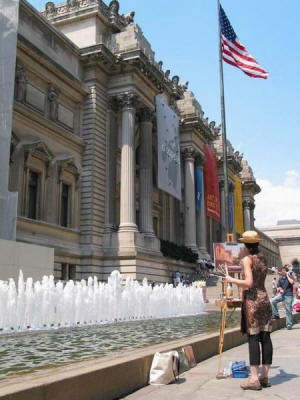 |
The Metropolitan Museum of Art, oftentimes referred to simply as "the Met", is one of the earth's largest and most important art museums. The main building is located on the eastern edge of Primal Park in New York Urban center, New York, U.s., forth what is known every bit Museum Mile. It was designated a National Historic Landmark in 1986. The Met has a much smaller second location at "The Cloisters," featuring medieval art. | |||||||||||||||
| 8 | Brooklyn Span | |||||||||||||||
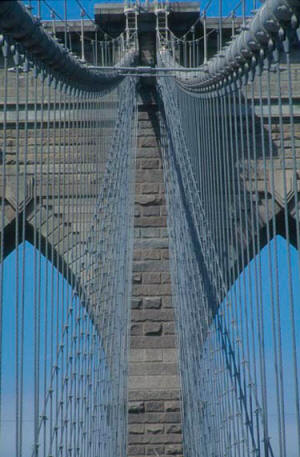 |
The Brooklyn Bridge, 1 of the oldest break bridges in the United States, stretches five,989 feet (1825 m)[one] over the East River connecting the New York City boroughs of Manhattan and Brooklyn. On completion, it was the largest suspension span in the world and the offset steel-wire suspension bridge. Originally referred to as the New York and Brooklyn Bridge, information technology was dubbed the Brooklyn Bridge in an 1867 letter to the editor of the Brooklyn Daily Eagle,[2] and formally so named past the metropolis government in 1915. Since its opening, information technology has go an iconic role of the New York skyline. In 1964 it was designated a National Historic Landmark. | |||||||||||||||
| 9 | St. John the Divine | |||||||||||||||
 |
The Cathedral of St. John the Divine, officially the Cathedral Church of Saint John the Divine in the Metropolis and Diocese of New York, is the Cathedral of the Episcopal Diocese of New York. Located at 1047 Amsterdam Avenue New York, NY 10025 (between West 110th Street, which is likewise known as "Cathedral Parkway", and 113 Street) in Manhattan's Morningside Heights, the cathedral is claimed to be the largest cathedral and Anglican church and 3rd largest Christian church building in the world (although the championship is disputed with Liverpool Anglican Cathedral). The cathedral, designed in 1888 and begun in 1892, has, in its history, undergone radical stylistic changes and the interruption of the 2 World Wars. Information technology remains unfinished, with construction and restoration a continuing procedure. | |||||||||||||||
| 10 | TRINITY Church | |||||||||||||||
 |
Trinity Church building, at 74 Trinity Place in New York Metropolis, is a celebrated full service parish church in the Episcopal Diocese of New York. Trinity Church building is located at the intersection of Broadway and Wall Street in downtown Manhattan. St. Paul's Chapel, function of the Parish of Trinity Church, is the oldest public building in continuous use in New York City. | |||||||||||||||
| eleven | Woolworth Building | |||||||||||||||
 |
The Woolworth Building, at fifty-seven stories, is one of the oldest — and one of the near famous — skyscrapers in New York City. More ninety years afterward its structure, it is still 1 of the 50 tallest buildings in the United states every bit well every bit one of the twenty tallest buildings in New York City. The edifice is a National Celebrated Landmark, having been listed in 1966. | |||||||||||||||
| 12 | Waldorf-Astoria Hotel | |||||||||||||||
 |
Waldorf=Astoria Hotel and Park Avenue with Helmsley Building and Met Life Building in backgroundThe Waldorf-Astoria Hotel is a famously luxurious hotel in New York. Information technology has been housed in two historic landmark buildings of New York City. The first, designed by architect Henry J. Hardenbergh, was on the Fifth Avenue site of the Empire State Building. The present building at 301 Park Artery in Manhattan is a 47-story, 625 ft. (191 m) Art Deco landmark designed by architects Schultze and Weaver that dates from 1931 and is now part of the The Waldorf=Astoria Drove, a concatenation of very upscale hotels consisting of hotels previously of the Hilton Hotels and Conrad Hotels bondage, as well as some new hotels. The name, Waldorf=Astoria, now officially appears with a double hyphen, merely originally the single hyphen was employed, as recalled past a pop expression and song, "Encounter Me at the Hyphen." The modernistic hotel has three American and classic European restaurants, and a beauty parlor located off the main lobby. Several luxurious boutiques surround the distinctive lobby, which has won awards for its restoration to the original period grapheme. An even more luxurious, virtual "hotel within a hotel" in its upper section is known as The Waldorf Towers operated by Conrad Hotels & Resorts. | |||||||||||||||
| 13 | New York Public Library | |||||||||||||||
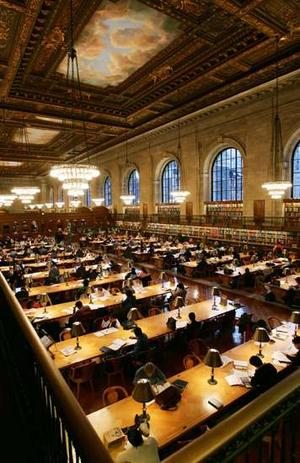 |
The New York Public Library (NYPL) is one of the leading public libraries of the world and is one of America'due south most meaning research libraries. It is unusual in that it is equanimous of a very large circulating public library system combined with a very large not-lending inquiry library arrangement. It is simultaneously i of the largest public library systems in the United states of america and one of the largest research library systems in the world. It is a privately managed, nonprofit corporation with a public mission, operating with both private and public financing. Its flagship edifice, on 5th Ave. running from 40th to 42nd Street in Manhattan, is a National Historic Landmark. The historian David McCullough has described the New York Public Library as one of the five about important libraries in America, the others beingness the Library of Congress, the Boston Public Library, and the university libraries of Harvard and Yale. Although it is chosen the "New York Public Library" the system does not encompass all five boroughs of America'south largest city, simply Manhattan, The Bronx and Staten Island. New York City does not accept a single public library system but iii of them. The other two are the Brooklyn Public Library and the Queens Borough Public Library, serving the boroughs of Brooklyn and Queens, respectively. This came most because these three library systems predate the consolidation of New York Urban center in 1898. | |||||||||||||||
| 14 | Hearst Magazine Building | |||||||||||||||
 |
Hearst Belfry in New York Urban center, New York is located at 300 West 57th Street on Eighth Artery, near Columbus Circle. It is the world headquarters of the Hearst Corporation, bringing together for the start time their numerous publications and communications companies under one roof, including Cosmopolitan, Proficient Housekeeping and the San Francisco Chronicle, to name a few. The old six-story headquarters building was commissioned past the founder, William Randolph Hearst and awarded to the builder Joseph Urban. The building was completed in 1928 at a toll of $two 1000000 and contained 40,000 sq. ft. The original cast rock facade has been preserved in the new design every bit a designated Landmark site. Originally congenital equally the base of operations for a proposed skyscraper, the construction of the belfry was postponed due to the Dandy Depression. The new tower addition was completed nearly eighty years later, and 2000 Hearst employees moved in on iv May 2006.[i] | |||||||||||||||
| 15 | Flatiron Edifice | |||||||||||||||
 |
The Fuller Building, meliorate known as the Flatiron Building, was 1 of the tallest buildings in New York Metropolis upon its completion in 1902. The building, at 175 5th Avenue in the borough of Manhattan, sits on a triangular island block at 23rd Street, Fifth Avenue, and Broadway, facing Madison Square. The Flatiron Building was designed by Chicago's Daniel Burnham in the Beaux-Arts style. Similar a classical Greek column, its limestone and glazed terra-cotta façade is separated into 3 parts horizontally. Since it was 1 of the start buildings to employ a steel skeleton, the building could be synthetic to 285 feet (87 m), which would have been very difficult with other construction methods of that fourth dimension. The initial design by Daniel Burnham shows a similar design to the one constructed, simply with a far more elaborate crown with numerous setbacks about the top. A clock face tin can besides exist seen. However, this was subsequently removed from the design. | |||||||||||||||
| 16 | Solomon R. Guggenheim Museum | |||||||||||||||
 |
Originally called "The Museum of Non-Objective Painting," the Guggenheim was founded to showcase avant-garde fine art by early modernists such as Wassily Kandinsky and Piet Mondrian. It moved to its nowadays location, at the corners of 89th Street and Fifth Avenue (overlooking Central Park), in 1959, when Frank Lloyd Wright'south design for the site was completed. The distinctive building, Wright's last major piece of work, instantly polarized architecture critics, though today it is widely revered. From the street, the building looks approximately like a white ribbon curled into a cylindrical stack, slightly wider at the top than the lesser. Its appearance is in abrupt dissimilarity to the more than typically indigestible Manhattan buildings that surround it, a fact relished by Wright who claimed that his museum would make the nearby Metropolitan Museum of Fine art "wait like a Protestant barn." Internally, the viewing gallery forms a gentle screw from the ground level upwardly to the top of the building. Paintings are displayed forth the walls of the screw and also in viewing rooms institute at stages forth the way. | |||||||||||||||
| 17 | The Plaza Hotel | |||||||||||||||
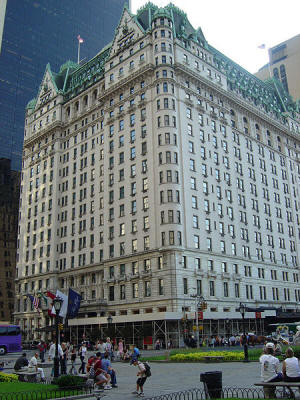 |
"The Plaza has been able to maintain its standings over the years. The Plaza'south various public rooms accept undergone numerous incarnations. The large room on the corner of Xl-ninth Street and the Plaza, which was called simply the "restaurant," assumed various decors as the Edwardian Room and the Dark-green Tulop, and the 50-ninth Street dining room that served as the office of Jules Bache has get, and Remains, the Oak Room." "Finally, the Plaza houses New York's i functioning Palm Court, and it has a decorated day. Breakfasts and salad lunches are served, and no sooner are the last leaves of lettuce carried abroad than a violinist and pianist turn up and a flame is put under the tea kittles and cocoa in the kitchens. This does not mean, still, that the Plaza has not plugged ahead into the hereafter. Not only does it provide its guests with closed excursion television and choice of two movies daily, merely troubleshooting hostesses called "service coordinators," together speaking all of 15 languages, patrol the anteroom and halls where once private maids and lackies scurried obediently." The Plaza Hotel, ane of New York city's finest hotels, was architecturally designed imitating the manner of a late medieval French chateaux. The elegant lobby contains ornamented archways, pillars, and marble floors. This combined with a usage of the color gold requite the hotel a wealthy, upper-course appearance. | |||||||||||||||
| 18 | Lincoln Center | |||||||||||||||
 |
Lincoln Center for the Performing Arts is a 16.3-acre (61,000 m²) complex of buildings in New York Metropolis which serves as home for 12 arts organizations: Sleeping accommodation Music Guild of Lincoln Center, Film Club of Lincoln Center, Jazz at Lincoln Centre, Juilliard School, Lincoln Eye Theater, Metropolitan Opera, New York City Ballet, New York City Opera, New York Combo, New York Public Library for the Performing Arts, Schoolhouse of American Ballet, and Lincoln Eye for the Performing Arts, Inc.. | |||||||||||||||
| 19 | Dakota Apartments | |||||||||||||||
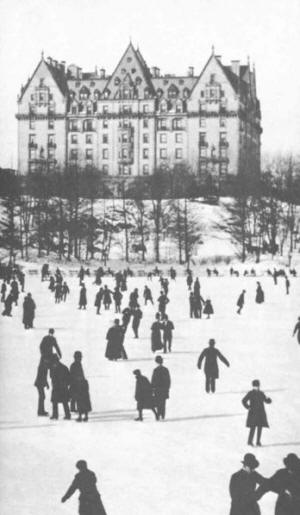 |
The architectural firm of Henry Janeway Hardenbergh was deputed to exercise the design for Edward Clark, head of the Vocaliser Sewing Auto Visitor whose firm besides designed the Plaza Hotel. The edifice's high gables and deep roofs with a profusion of dormers, terra cotta spandrels and panels, niches, balconies and balustrades give information technology a Northward German Renaissance character, an echo of a Hanseatic townhall. Nevertheless, its layout and floor plan betray a stiff influence of French architectural trends in housing design that had get known in New York in the 1870s. According to popular fable, the Dakota was so named because at the time it was built, the Upper West Side of Manhattan was sparsely inhabited and considered every bit remote every bit the Dakota Territory. However, the earliest recorded appearance of this account is in a 1933 paper story. It is more likely that the building was named "The Dakota" because of Clark'due south fondness for the names of the new western states and territories. High in a higher place the 72nd Street archway, the figure of a Dakota Indian keeps lookout man. The Dakota was added to the National Register of Historic Places in 1972, and was declared a National Historic Landmark in 1976. | |||||||||||||||
| 20 | Radio City Music Hall | |||||||||||||||
 |
The 12 acre (49,000 thousand²) complex in midtown Manhattan known equally Rockefeller Center was adult between 1929 and 1940 by John D. Rockefeller, Jr., on land leased from Columbia Academy. Rockefeller initially planned a new habitation for the Metropolitan Opera on the site, but after the Stock Market place Crash of 1929, the plans changed and the opera company withdrew from the project. The names "Radio City" and "Radio City Music Hall" derive from 1 of the complex'due south first tenants, the Radio Corporation of America. Radio Urban center Music Hall was a project of Rockefeller, Samuel Roxy Rothafel who previously opened the Roxy Theater in 1927, and RCA chairman David Sarnoff. RCA had developed numerous studios for NBC at 30 Rockefeller Plaza, just to the southward of the Music Hall, and the radio-Tv circuitous that lent the Music Hall its name is still known as the NBC Radio Metropolis Studios. The Music Hall opened to the public on December 27, 1932 with a spectacular stage show, featuring Ray Bolger and Martha Graham. The opening was meant to be a return to high class variety entertainment. Unfortunately, information technology was not a success and on January 11, 1933, the starting time film was shown on the giant screen: Frank Capra's The Bitter Tea of Full general Yen starring Barbara Stanwyck. | |||||||||||||||
| 21 | Time Warner Heart | |||||||||||||||
 |
Originally constructed as the "AOL Time Warner Center," the building surrounds half of Columbus Circle in Midtown Manhattan. The full floor expanse of 260,000 m² (2.8 meg ft²) is divided between offices (notably the offices of Time Warner Inc.), residential condominiums, and the Standard mandarin Oriental hotel. The Shops at Columbus Circle is an upscale shopping mall located in a curving arcade at the base of the building, with a large Whole Foods Market grocery shop in the basement. The circuitous is too home to a 1,200 seat theater for Jazz at Lincoln Center likewise as CNN studios, from where Anderson Cooper 360° and Lou Dobbs Tonight, among other shows, are broadcast live. CNN's Jeanne Moos, known for her offbeat "man on the street" reporting, frequently accosts her interview subjects just outside the building. In 2005, Jazz at Lincoln Middle announced a partnership with XM Satellite Radio which gave XM studio space at Frederick P. Rose Hall to broadcast both daily jazz programming and special events such as an Aartist Confidential show featuring Carlos Santana. | |||||||||||||||
| 22 | United nations Headquarters | |||||||||||||||
 |
The United Nations Headquarters were constructed in New York City in 1949 and 1950 beside the East River, on seventeen acres of land purchased from the foremost New York real estate developer of the time, William Zeckendorf. This purchase was arranged by Nelson Rockefeller, after an initial offer of placing it on the Rockefeller family manor of Kykuit was rejected equally beingness besides isolated from Manhattan. The $8.5 million purchase was then funded by his father, John D. Rockefeller, Jr., who donated it to the Metropolis. The lead builder for the building was the real estate firm of Wallace Harrison, the personal architectural adviser for the family. | |||||||||||||||
| 23 | TWA TerminalJFK Aerodrome | |||||||||||||||
 |
| |||||||||||||||
| 24 | Citicorp Centre | |||||||||||||||
 |
From the beginning, the Citigroup Heart was an engineering challenge. When planning for the skyscraper began in the early on 1970s, the northwest corner of the proposed building site was occupied past St. Peter'south Lutheran Church. The church allowed Citicorp to demolish the old church and build the skyscraper under one condition: a new church would have to exist built on the same corner, with no connectedness to the Citicorp edifice and no columns passing through it, because the church wanted to remain on the site of the new development, near i of the intersections. Architects wondered at the time if this demand was too much, and if the proposal could even work. Structural engineer William LeMessurier set the 59-story tower on four massive 114 foot (35 m) high columns, positioned at the middle of each side, rather than at the corners. This blueprint allowed the northwest corner of the building to cantilever 72 feet (22 m) over the new church. To accomplish these goals LeMessurier designed a system of stacked load bearing braces, in the form of inverted chevrons. Each chevron would redirect the massive loads to their center, then downward into the ground through the uniquely-positioned columns. | |||||||||||||||
| 25 | Museum of Modern Fine art | |||||||||||||||
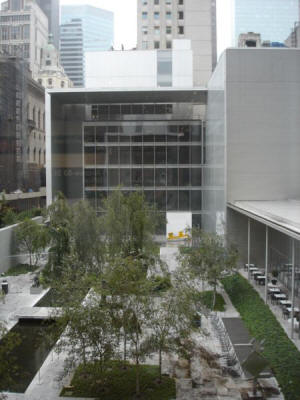 |
The Museum of Modern Art (MoMA) is a preeminent art museum located in Midtown Manhattan in New York Urban center, United states, on 53rd Street, between Fifth and Sixth Avenues. It has been singularly important in developing and collecting modernist art, and is frequently identified as the most influential museum of modernistic art in the world.[1] The museum'southward collection offers an unparalleled overview of modern and contemporary art, [two] including works of architecture and design, drawings, painting, sculpture, photography, prints, illustrated books, film, and electronic media. MoMA'due south library and archives agree over 300,000 books, artist books, and periodicals, likewise as private files on more than lxx,000 artists. The athenaeum contain main source fabric related to the history of modern and contemporary art. | |||||||||||||||
Source: https://www.nyc-architecture.com/TEN/TEN-NY.htm
0 Response to "High School of Art and Design Class 57 St 2nd Avwnuw New York Ny"
Post a Comment